
H.P. Lovecraft declared Edgar Allan Poe to be his "god of fiction". The HPLHS is pleased to present an audiobook of Poe's complete works, covering 66 stories, his only completed novel, his unfinished play and his poems both major and minor in a collection comprising more than forty hours of professionally recorded audio. The stories are read by HPLHS founders and trained actors Sean Branney and Andrew Leman. The recordings feature original music by Reber Clark. Over two years in the making, this collection gathers all of Poe's fiction and verse into one collection.
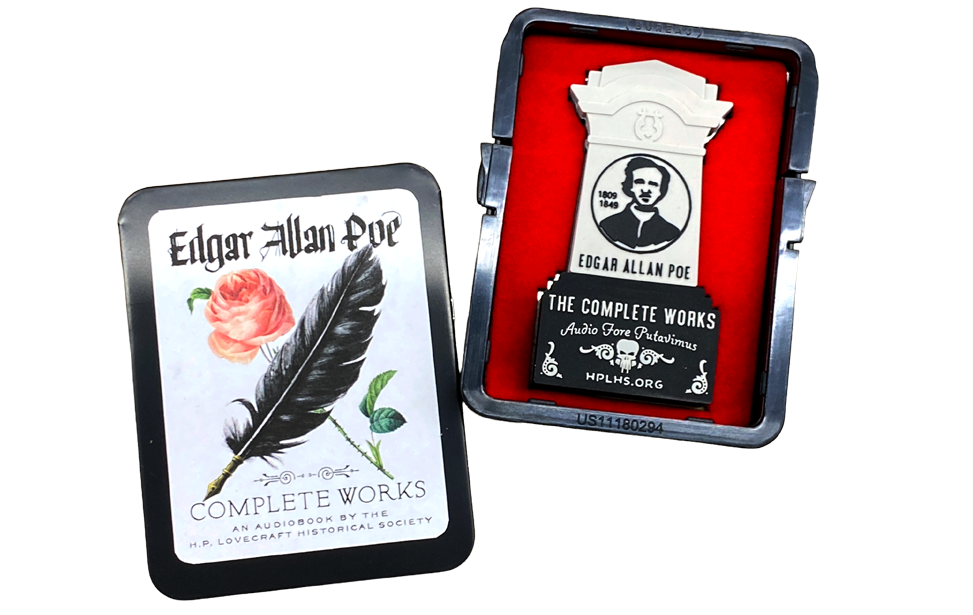
Edgar Allan Poe: Complete Works is available in a Collector’s Edition featuring a velvet-lined metal casket which holds a custom-made 16GB thumb drive in the shape of Poe's Baltimore tombstone containing all of the material in individual files. All you have to do is break open his casket and violate his tombstone and you can plug it in to your computer, car, or any other compatible device! Download editions of the Complete Works as well as a subset of The Best Of are available through the HPLHS’s online store.
Order now!SAMPLES
Below are samples of the audio in the collection. We're pleased to offer complete readings of "The Imp of the Perverse" and "The Black Cat", along with brief clips of other stories and poems.

Where Do I Start?
 A traditional book is a self-contained random access device: you can open it to any page you want and just start reading. But for an audiobook which might get played on a computer or a car stereo or a smartphone or wherever with varying degrees of control, and for those who might not be familiar with all of these stories, we wanted to provide some suggestions for ways to approach this large collection.
We've organized the audio files in this collection by groups, and alphabetically within those groups. If you’re already familiar with Poe’s works, we suggest you simply dive in and start listening to some of your favorite stories. If you’re new to Poe, we suggest you start with our BEST OF POE list in the tab to the right — once you’ve heard those pieces, you can explore the rest of them on your own. We have some other suggestions in other tabs here.
How to Listen
This is a big collection and if you want to know where to start, here are some acknowledged classics, along with a few less famous pieces we enjoyed and thought were worth highlighting....
The Tell-Tale Heart
The Cask of Amontillado
The Fall of the House of Usher
Hop-Frog
The Gold-Bug
A Descent into the Maelström
The Murders in the Rue Morgue
William Wilson
Ligeia
The Imp of the Perverse
A Tale of the Ragged Mountains
The Man of the Crowd
The Premature Burial
The Pit and the Pendulum
The Purloined Letter
The Facts in the Case of M. Valdemar
The Spectacles
MS. Found in a Bottle
The Black Cat
The Masque of the Red Death
and poems "The Raven", "The Bells", "Annabel Lee" and "Alone"
If you’re academically inclined and want to follow the development of Edgar Allan Poe's career as an author, this Chronological List can be an interesting way to approach the stories.
Alone (1829)
Al Aaraaf (1829)
The City in the Sea (1831)
Metzengerstein (1832)
The Duc de L'Omelette (1832)
A Tale of Jerusalem (1832)
Loss of Breath (1832)
Bon-Bon (1832)
MS. Found in a Bottle (1833)
The Coliseum (1833)
The Assignation (1834)
Berenice (1835)
Morella (1835)
Lionizing (1835)
The Unparalleled Adventure of one Hans Pfaall (1835)
King Pest (1835)
Shadow — A Parable (1835)
Epimanes (1836)
Mystification (1837)
Silence — A Fable (1838)
Ligeia (1838)
How to Write a Blackwood Article/A Predicament (1838)
The Devil in the Belfry (1839)
The Man That Was Used Up (1839)
The Fall of the House of Usher (1839)
William Wilson (1839)
The Conversation of Eiros and Charmion (1839)
Why the Little Frenchman Wears His Hand in a Sling (1840)
The Business Man (1840)
The Man of the Crowd (1840)
The Murders in the Rue Morgue (1841)
A Descent into the Maelström (1841)
The Island of the Fay (1841)
The Colloquy of Monos and Una (1841)
Never Bet the Devil Your Head (1841)
Eleonora (1841)
Three Sundays in a Week (1841)
The Oval Portrait (1842)
The Masque of the Red Death (1842)
The Domain of Arnheim (1842)
The Mystery of Marie Roget (1842)
The Conqueror Worm (1843)
The Pit and the Pendulum (1843)
The Tell-Tale Heart (1843)
The Gold-Bug (1843)
The Black Cat (1843)
Diddling Considered as One of the Exact Sciences (1843)
The Spectacles (1844)
A Tale of the Ragged Mountains (1844)
The Premature Burial (1844)
Mesmeric Revelation (1844)
The Oblong Box (1844)
The Angel of the Odd (1844)
Thou Art the Man (1844)
The Literary Life of Thingum Bob, Esq. (1844)
The Purloined Letter (1844/5)
The Raven (1845)
The Thousand-and-Second Tale of Scheherezade (1845)
Some Words with a Mummy (1845)
The Power of Words (1845)
The Imp of the Perverse (1845)
The System of Doctor Tarr and Professor Fether (1845)
The Facts in the Case of M. Valdemar (1845)
The Sphinx (1846)
The Cask of Amontillado (1846)
Ulalume (1847)
The Domain of Arnheim (1847)
Mellonta Tauta (1849)
Hop-Frog (1849)
Von Kempelen and his Discovery (1849)
X-ing a Paragrab (1849)
Landor's Cottage (1849)
The Bells (1849)
Annabel Lee (1849)
Poe was a literary innovator whose work straddled existing genres and invented new ones, and it is not possible to definitively categorize this material. Scholarly editors and anthologizers differ in their opinions on the matter, and a number of the titles listed below could just as easily be categorized in another way. However, to assist listeners who are less familiar with the breadth of Poe's genius, we humbly offer the following rough groupings in the hope it will help you find something to fit your mood. While he's certainly most famous for the macabre and horrifying, you might be surprised by how much of what Poe wrote was comedy!
TALES OF HORROR
Berenice
The Black Cat
The Cask of Amontillado
The Facts in the Case of M. Valdemar
The Fall of the House of Usher
Hop-Frog
The Imp of the Perverse
King Pest
Ligeia
The Masque of the Red Death
Metzengerstein
Morella
The Oblong Box
The Oval Portrait
The Pit and the Pendulum
The Premature Burial
The Tell-Tale Heart
DETECTIVE and ADVENTURE STORIES
A Descent into the Maelström
The Gold-Bug
The Light-House
The Man of the Crowd
MS. Found in a Bottle
The Murders in the Rue Morgue
The Mystery of Marie Roget
The Narrative of Arthur Gordon Pym of Nantucket
The Purloined Letter
A Tale of the Ragged Mountains
The Unparalleled Adventure of one Hans Pfaall
PHILOSOPHICAL and FANTASTICAL TALES
The Assignation
The Colloquy of Monos and Una
The Conversation of Eiros and Charmion
The Domain of Arnheim
Eleonora
The Island of the Fay
Mesmeric Revelation
Morning on the Wissahiccon
The Power of Words
Shadow — A Parable
Silence — A Fable
William Wilson
SATIRES and HOAXES
The Angell of the Odd
The Balloon Hoax
Bon-Bon
The Business Man
A Decided Loss
The Devil in the Belfry
Diddling Considered as one of the Exact Sciences
The Duc de L'Omelette
Epimanes
How to Write a Blackwood Article/A Predicament
Lionizing
The Literary Life of Thingum Bob, Esq.
The Man that was Used Up
Mellonta Tauta
Mystification
Never Bet the Devil Your Head
Some Words with a Mummy
The Spectacles
The Sphinx
The System of Doctor Tarr and Professor Fether
A Tale of Jerusalem
Thou Art the Man
The Thousand-and-Second Tale of Scheherezade
Three Sundays in a Week
Von Kempelen and his Discovery
Why the Little Frenchman Wears his Hand in a Sling
X-ing a Paragrab
In addition to the stories and poems, we have provided an audio Foreword, a discussion of Poe's influence on Lovecraft, and a file of Outtakes (listeners offended by mispronunciations, mangled French and salty language should feel free to skip this one). There is also a Listening Guide/Read Me PDF file.
It is for practical purposes impossible to present the truly "complete" works of Edgar Allan Poe. He was actively involved in the publication of much of his own writing, and felt free to revise it from edition to edition, changing titles along the way. To make things more complicated, his literary executor, Rufus Griswold, despised Poe and deliberately undermined his legacy. Given this complex situation, we decided to focus on his fiction and poetry, and thereby omitted a few things. We have not included any of his essays or literary reviews, or any of his correspondence. We did not include his unfinished novel The Journal of Julius Rodman, and there are a handful of minor poems, some never published in Poe's lifetime, that did not make the cut. We hope you'll nevertheless find something new and unfamiliar in this comprehensive collection. We certainly did!
We consulted a number of sources, but none more frequently or helpfully than the website of The Edgar Allan Poe Society of Baltimore. This non-profit organization has been working to preserve and disseminate the works of Poe since 1923, and is run entirely by volunteers. Their website isn't fancy, but it is scrupulously comprehensive and provides links to Poe's works and vast amounts of supporting material. They rely for their operations on donations and memberships. We have joined, and if you enjoy this collection perhaps you'll consider supporting their noble efforts.
A few do, yes. Poe lived when human slavery was still legal, and occasionally used a notorious racial slur. We have used a modern bleeping sound to censor that word, and only that word, when it appears. Other racist language and attitudes have been presented, sometimes awkwardly, as written. In the story "The Gold-Bug", some listeners may find the notion of a white narrator reading the words of a white author depicting a black character in vintage "slave dialect" offensive. Our intent is neither to mock nor denigrate the character of Jupiter, nor anyone else. Rather it is to depict this character in the manner that Mr. Poe wrote him: a manner frequently used by 19th-century white authors. For a more nuanced and contemporary examination of these issues, we encourage listeners to enjoy the novel James by Percival Everett, as it explores these issues in a thoughtful and entertaining manner.
Yes, they do. Footnotes are easy to recognize and read (or ignore) on the printed page, but it is challenging to render them in an audiobook format. Rather than omit them, however, we decided to include them as best we could. Whenever Poe inserts a footnote in his text, you will hear a pleasant piano glissando sound, and then the reader will provide the footnote with a slightly different audio quality so you can readily recognize when the footnote ends and the regular text resumes.
Despite our most vigilant efforts, there are always errors that arise in the process of recording stories — those are solely our fault and we apologize for them. We fix the ones we can, but some of them may remain. You do not need to write in and tell us about any imperfections you may find — we just hope you and the Edgar Allan Poe Society of Baltimore will forgive us. If you really want to point out a mistake you've found, here's where you can write to us.
Politian is Edgar Allan Poe's only attempt at writing a play. He was inspired by a real criminal case that occurred in Kentucky in 1825: the murder of Solomon Sharpe by Jereboam Beauchamp. This so-called "Kentucky Tragedy" made national headlines and served as the basis for a number of literary/fictional adaptations. Poe decided to set his version in 16th-century Rome, and write in the style of Jacobean-era blank verse.
The play was published in installments in The Southern Literary Messenger in 1835, but it was not well received and Poe gave up on it before it was finished. He refocused his efforts on short stories instead, which is undoubtedly for the best.
Since it was never completed, it's impossible to know if Poe ultimately intended it as a comedy or a tragedy: it could go either way. It has seldom been seen on any stage. There was one attempt in France in 1925 that never got off the ground, and in 1933 a college production was mounted at the University of Virginia.
We wanted to include Politian in this collection, but with so many characters it's not possible for just one person to read it out loud in audiobook style. So we drafted some of the talented colleagues who have worked with us on our Dark Adventure Radio Theatre series to join us. We thank these intrepid actors for taking on this challenging text. The HPLHS is proud to present this extremely rare dramatic reading of the work.
Although that sounds like fun, please don’t post these on the internet or make digital copies. If you really want to use excerpts in some project, write to us and let’s talk.
Included Stories
The Angel of the Odd
The Assignation (aka The Visionary)
The Balloon Hoax
Berenice
The Black Cat
Bon-Bon (aka The Bargain Lost)
The Business Man (aka Peter Pendulum)
The Cask of Amontillado
The Colloquy of Monos and Una
The Conversation of Eiros and Charmion
A Decided Loss (aka Loss of Breath)
A Descent into the Maelström
The Devil in the Belfry
Diddling Considered as One of the Exact Sciences
The Domain of Arnheim (aka The Landscape Garden)
The Duc de L'Omelette
Eleonora
Epimanes (aka Four Beasts in One)
The Facts in the Case of M. Valdemar
The Fall of the House of Usher
The Gold-Bug
Hop-Frog
How to Write a Blackwood Article/A Predicament
The Imp of the Perverse
The Island of the Fay
King Pest
Landor's Cottage
Ligeia
The Light-House
Lionizing
The Literary Life of Thingum Bob, Esq.
The Man of the Crowd
The Man That Was Used Up
The Masque of the Red Death
Mellonta Tauta
Mesmeric Revelation
Metzengerstein
Morella
Morning on the Wissahiccon (aka The Elk)
MS. Found in a Bottle
The Murders in the Rue Morgue
The Mystery of Marie Roget
Mystification (aka Von Jung)
The Narrative of Arthur Gordon Pym of Nantucket
Never Bet the Devil Your Head
The Oblong Box
The Oval Portrait (aka Life in Death)
The Pit and the Pendulum
Politian
The Power of Words
The Premature Burial
The Purloined Letter
Shadow — A Parable
Silence — A Fable
Some Words with a Mummy
The Spectacles
The Sphinx
The System of Doctor Tarr and Professor Fether
A Tale of Jerusalem
A Tale of the Ragged Mountains
The Tell-Tale Heart
Thou Art the Man
The Thousand-and-Second Tale of Scheherezade
Three Sundays in a Week
The Unparalleled Adventure of one Hans Pfaall
Von Kempelen and his Discovery
Why the Little Frenchman Wears His Hand in a Sling
William Wilson
X-ing a Paragrab
Included Poems
Al Aaraaf
Al Aaraaf (Annotated)
Alone
Annabel Lee
The Bells
The City in the Sea
The Coliseum
The Conqueror Worm
Dream-Land
Dreams
A Dream Within a Dream
Eldorado
For Annie
The Haunted Palace
Irene
O, Tempora! O, Mores!
The Raven
The Spirits of the Dead
Tamerlane
To Helen
Ulalume
The Valley of Unrest
Plus 44 Minor Poems
With only one exception, these are NOT dramatizations like our Dark Adventure Radio Theatre - rather, this is an audiobook of the original stories, in all-new, never-before-heard recordings. The exception is Poe's never-completed play, Politian, which we have produced as a dramatic reading with a full cast of very talented actors.
Some of this material was recorded at Horse Latitudes studio in Glendale, CA. Our thanks to engineer Marco Moir. Our thanks also go to Reber Clark for his music and to Amir Abdullah for his wise guidance on the handling of racially charged language. And thanks to Kevin Stidham for enduring a lot of listening.

The H.P. Lovecraft Historical Society is an international organization for fans of the author H.P. Lovecraft. The Society produces motion pictures, audio dramas, musical projects, publications, prop replicas and much more - all of which take Lovecraft’s creations to a whole new level. Our motto is "Ludo Fore Putavimus" (We Thought It Would be Fun).
Useful Links
Contact Us
Glendale, CA 91201
U.S.A.
Phone: (747) 215-6422
Email: keeper@cthulhulives.org
1984–2026 © HPLHS; All Rights Reserved. Privacy Policy | Terms of Service